doi:10.7910/DVN/CGOCUS · 6-V-2026
Whom were they willing to sign with?
Speaking against someone is public and cheap; signing a measure with another deputy requires prior agreement, nearly always reached off the record.
Afinidades Elegidas (CGOCUS)
Afinidades Elegidas is a dataset derived from Luz y Taquígrafos, with its own deposit. It records who signed with whom in the Congress, from 1931 to 1939. The numbers on this page come from its deposit.
The name – literally Elective Affinities – comes from Goethe's elective affinity, which Max Weber brought into sociology. «Elegidas» (chosen), rather than «electivas» (elective), stresses the decision of the person who signs. It also allows another reading: the affinities of those elected.
CGOCUS · 63,507 pair–measure relations · 1,530 measures
Signing is not speaking
A measure is a bill, an amendment, a collective request, an interpellation or another document signed by two or more deputies. Afinidades takes them from the same Diarios de Sesiones, the official printed record of the Cortes' proceedings, and identifies each signatory.
Two deputies who sign the same measure form a relation. Its weight is the number of measures they share.
The dataset holds 63,507 pair–measure relations: one for each pair of signatories to each measure.
It covers the three legislatures of the Republic, from 1931 to 1939. The sessions held in Mexico, in 1945, are not included.
CGOCUS · 1,026 people · 78 in all three legislatures
Three legislatures in numbers
The Afinidades census has one record per deputy and legislature. It covers 1,026 people.
| Legislature | 1931-1933 | 1933-1936 | 1936-1939 |
|---|---|---|---|
| Deputies in the census | 475 | 470 | 501 |
| Sign at least one measure | 453 | 440 | 315 |
| Sign none (isolated) | 22 | 30 | 186 |
| Measures signed by two or more | 674 | 767 | 89 |
| Pair–measure relations | 30,345 | 27,172 | 5,990 |
| Signatories with no record in that legislature | 1 | 6 | 1 |
The last row counts signatories whom the census places in another legislature. They are not included in the rows above.
78 deputies sit in all three legislatures.
The 1936-1939 legislature left 89 measures signed by two or more deputies, against 767 in the previous one.
The census and the relations of Afinidades Elegidas call 1933-1936 the legislature that this dataset calls 1933-1935; the Diario's sessions end on 10 December 1935.
CGOCUS · denominator: the edgelist rows of each legislature
Did they cross blocs?
There are two ways of measuring whether deputies signed with the other side of the Chamber, and they tell different stories.
Each deputy falls into a bloc according to the ideology in their record. The left brings together the far left, the left and the centre-left; the right, the centre-right, the right and the far right. The centre lies between them.
Cross-bloc counts any pair from different blocs, the centre included. Strict counts only the left with the right.
The share of relations that cross blocs falls from 35.1% in 1931-1933 to 7.4% in 1936-1939.
Strict crossing does not fall steadily: 7.1%, 2.5% and 5.8%, legislature by legislature.
Did deputies sign with the other bloc?
Each bar is the cross-bloc share for its legislature. Its gold segment, the strict share, always starts from zero, so it can be compared across legislatures.
- 1931-19331931-1933 · Strict: left with right1931-1933 · Cross-bloc35.1%7.1%
- 1933-19361933-1936 · Strict: left with right1933-1936 · Cross-bloc23.0%2.5%
- 1936-19391936-1939 · Strict: left with right1936-1939 · Cross-bloc7.4%5.8%
And that strict crossing is concentrated in 16 of the legislature's 89 measures.
| Legislature | Cross-bloc | Strict | With the centre, within crossing | Pair–measure relations |
|---|---|---|---|---|
| 1931-1933 | 35.1% · 10,639 | 7.1% · 2,150 | 79.8% · 8,489 | 30,345 |
| 1933-1936 | 23.0% · 6,260 | 2.5% · 689 | 89.0% · 5,571 | 27,172 |
| 1936-1939 | 7.4% · 442 | 5.8% · 347 | 21.5% · 95 | 5,990 |
The pair–measure relations of each legislature: 30,345, 27,172 and 5,990.
CSV and Excel, with a README in Spanish and in English.
No form: these are aggregate data.
- Source
- Afinidades Elegidas (CGOCUS)
Checksum:V1.1
Numbers exported on - How to cite
- Rodrigues-Silveira, Rodrigo; García-Díez, Fátima; Llamazares, Iván; Martínez-Barahona, Elena; Barreto Martín, Eduardo. ‘Two kinds of crossing’. Figure from Luz y Taquígrafos. https://luz.parlaibero.es/en/afinidades/#cruces. Source: Afinidades Elegidas (CGOCUS) ·
V1.1. Exported on .
Before you read it ‘Cross-bloc’ counts any pair from left, centre and right; ‘strict’, only left with right. In 1936-1939 there are only 89 measures: it is not a comparable third snapshot.
With the keyboard: Tab moves to the figure; ← and → step through its marks; Home and End go to the first and the last; Esc closes the note.
Until the war, most crossing goes through the centre. In the Constituent Cortes, 79.8% of the cross-bloc relations have a signatory from the centre. In 1933-1936, 89.0%.
In 1936-1939 the centre almost disappears: it is present in 21.5% of the crossing. What remains is strict crossing.
The PNV counts on the right, because the census codes it as centre-right. In 1936-1939 it is present in 24.5% of the strict-crossing relations.
CGOCUS · 475 · 470 · 501 deputies in the census
Three networks
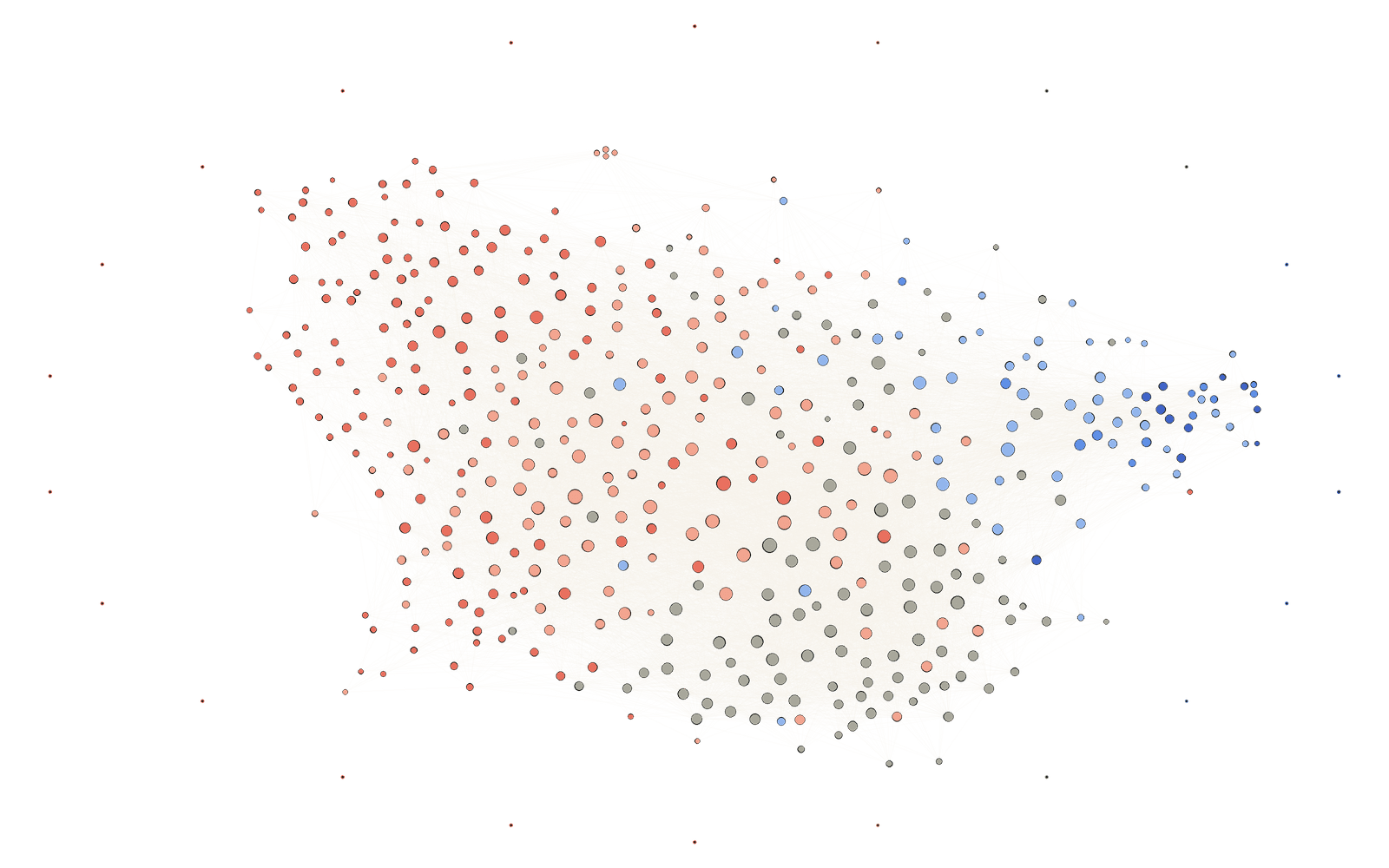
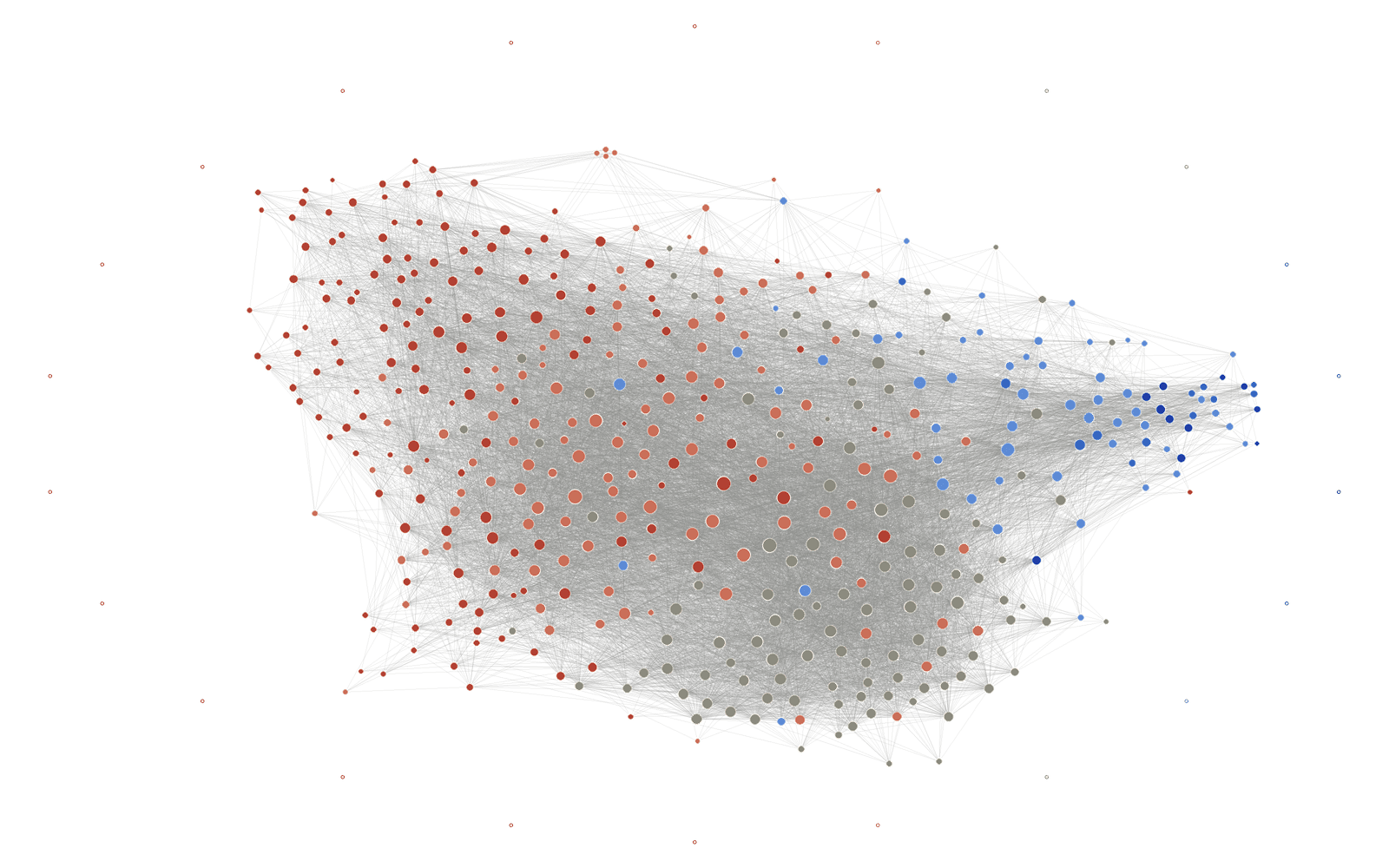
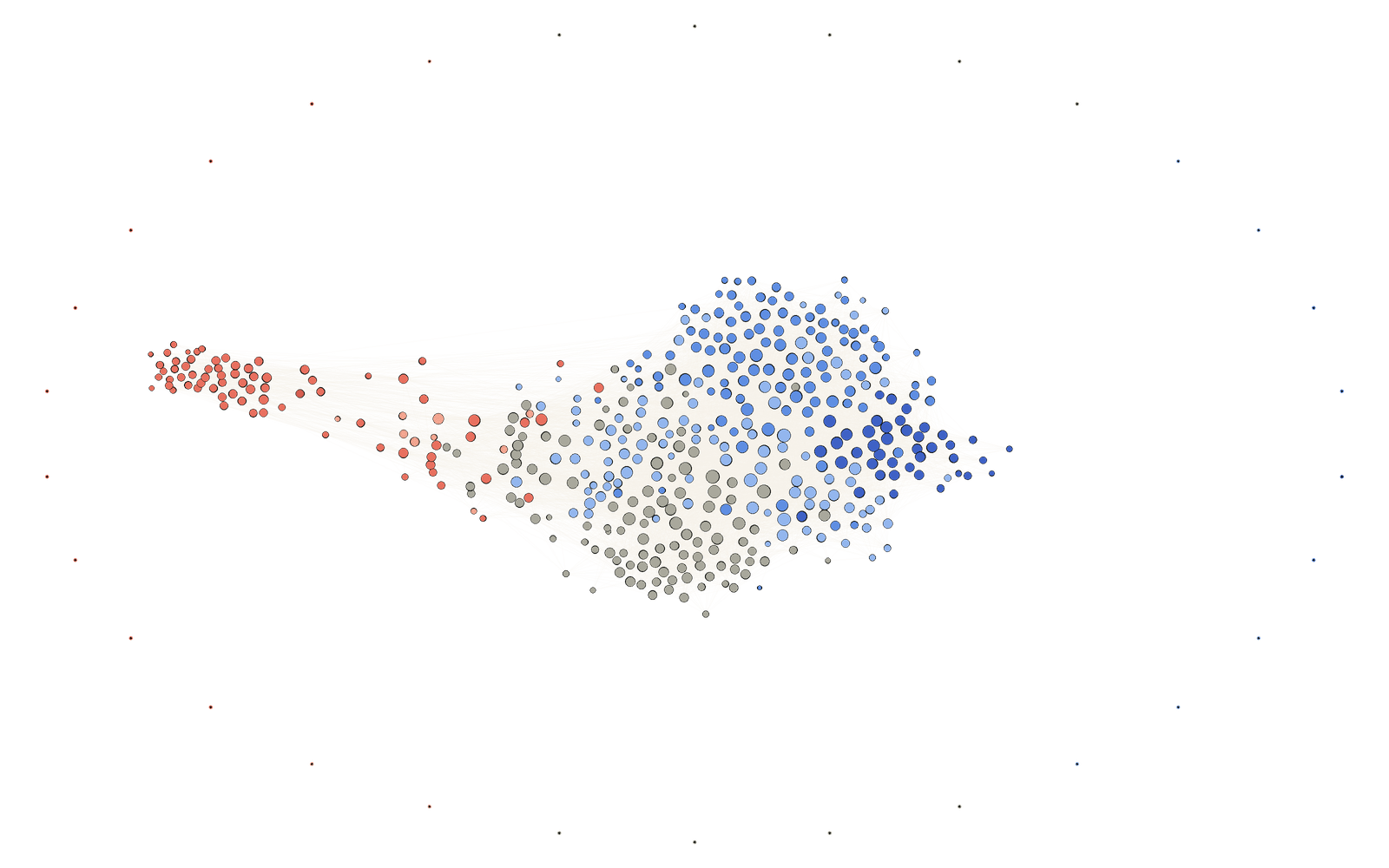
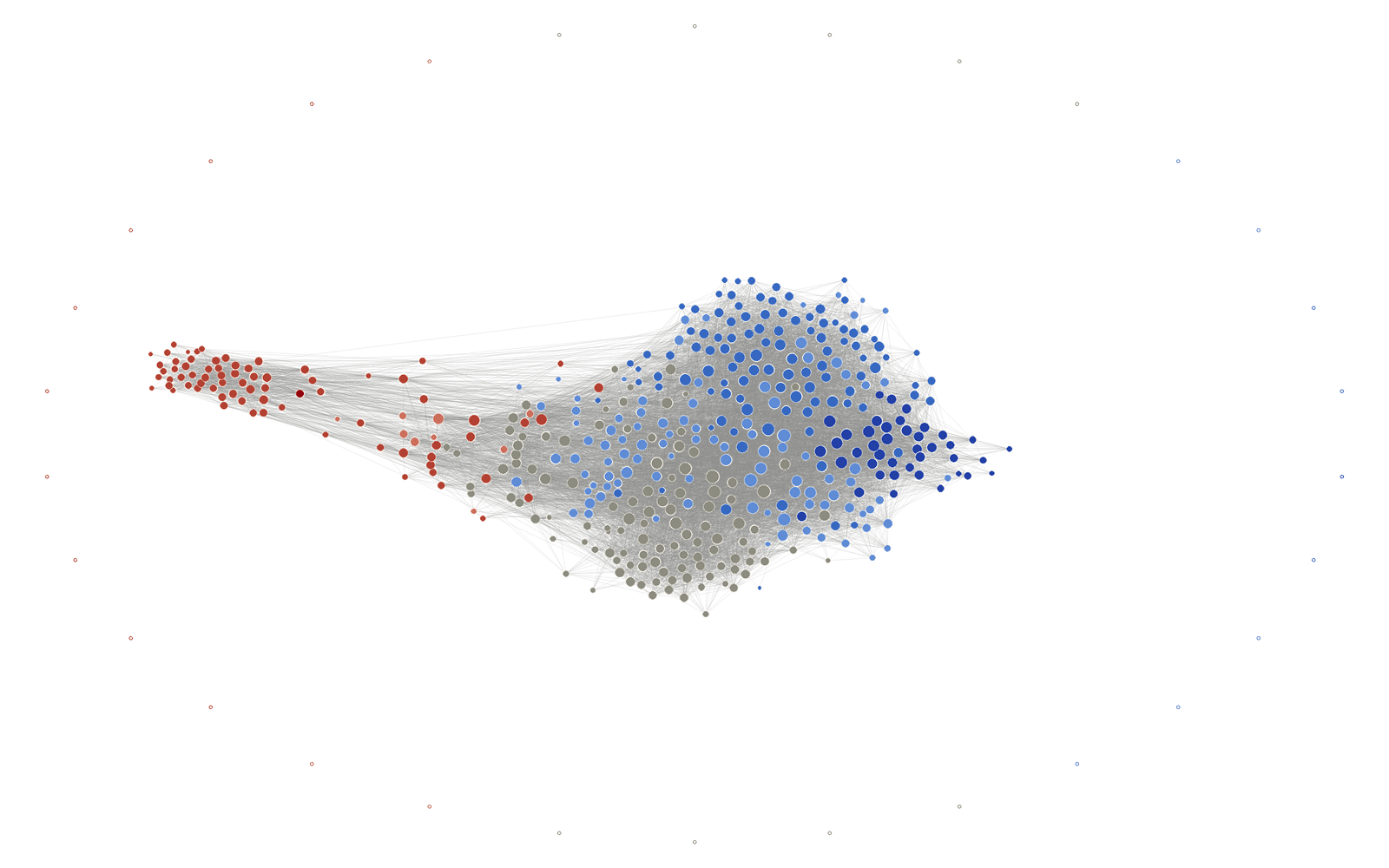
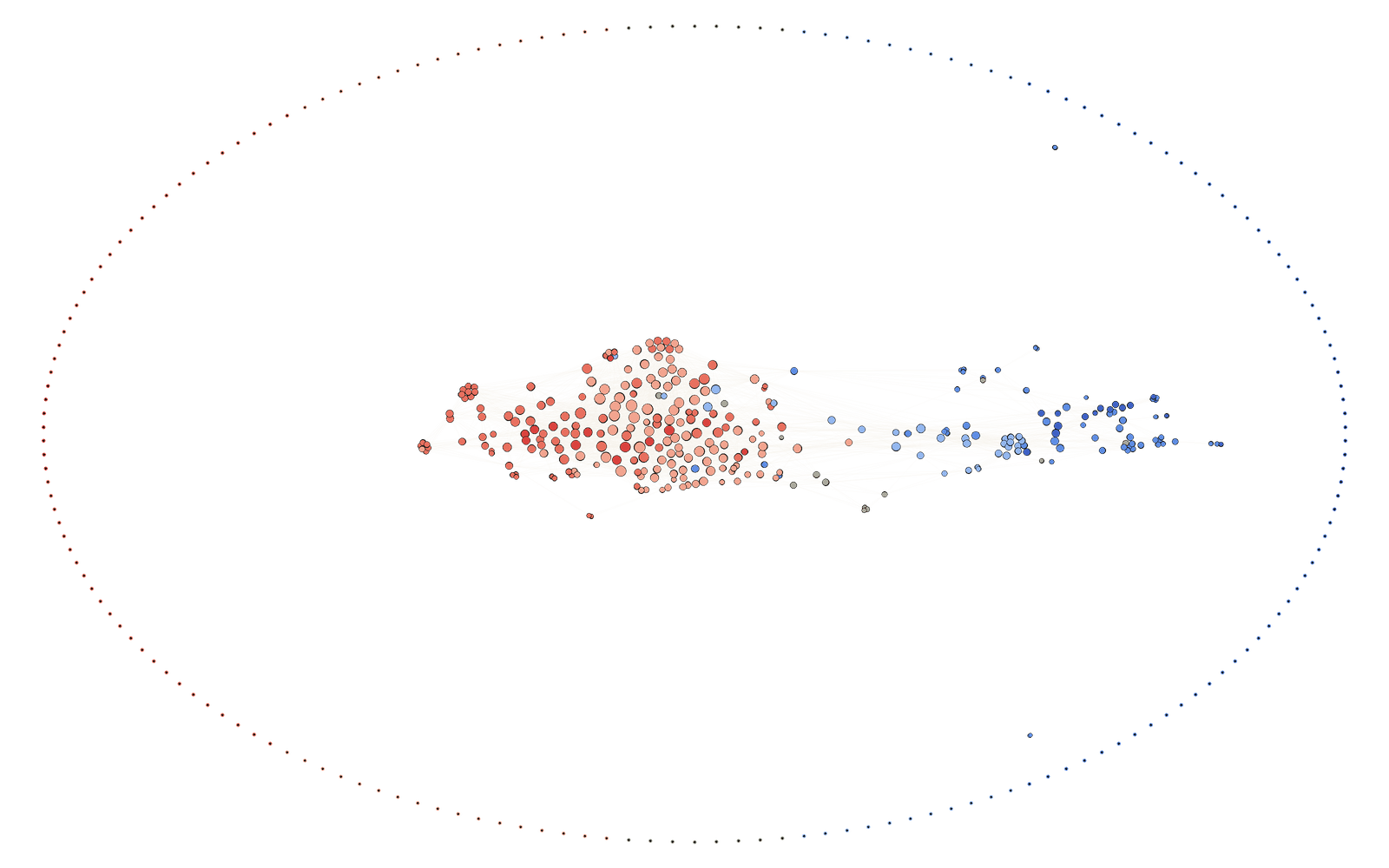
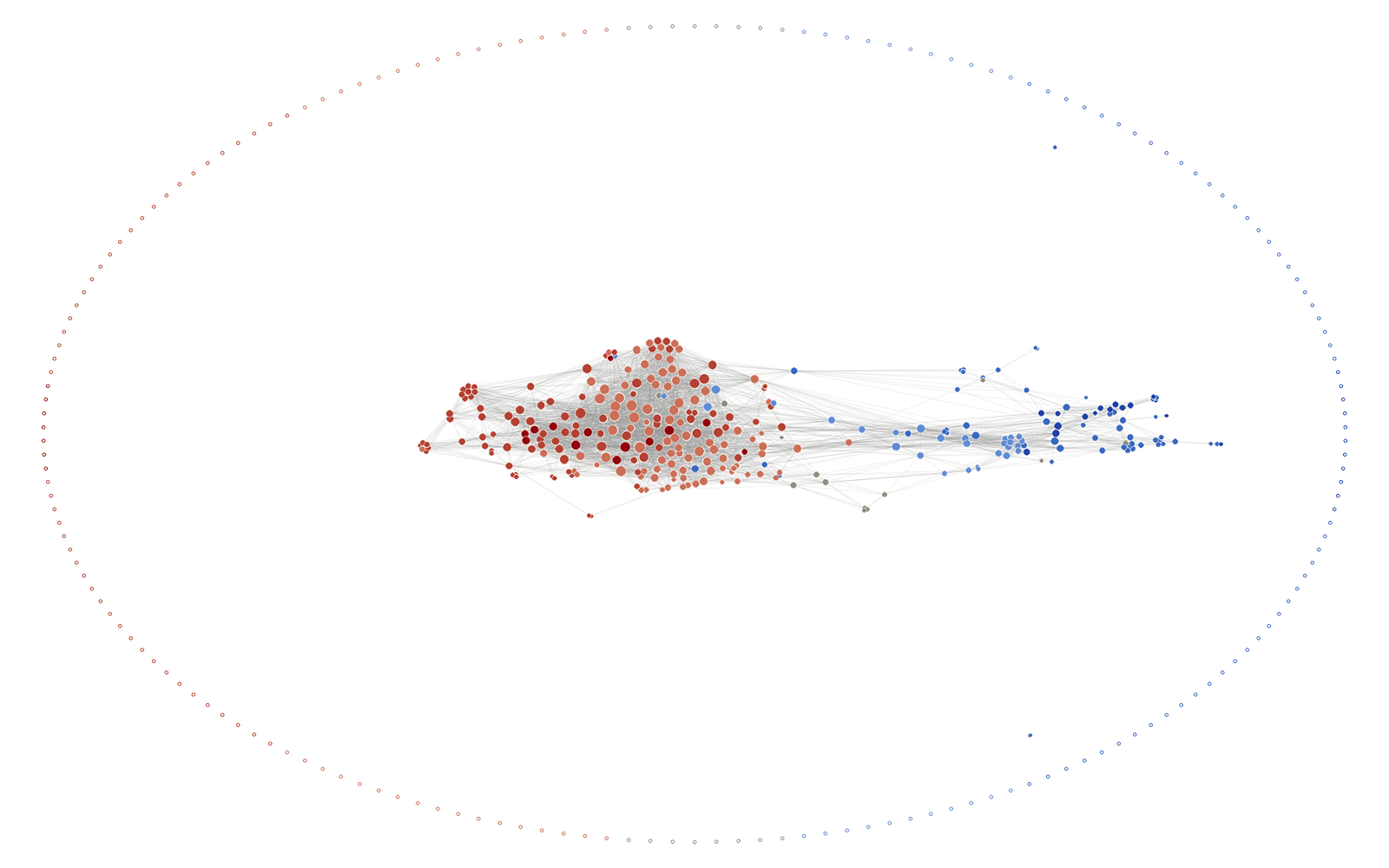
Each legislature has its network: one point per deputy in the census and one line for each pair who signed together.
Look up a deputy in the census list: the network highlights those who signed with them.
Who signed with whom?
Loading the figure…
The figure could not be loaded. Its data are still in the Table tab.
Ideology, according to the record
- Far left0120
- Left16182137
- Centre-left12112130
- Centre11112029
- Centre-right5510451
- Right15109107
- Far right124227
Loose, on the outer ring: those who signed with no one2230186
The size of the point grows with the number of deputies they signed with.
Of the 1,026 people in the census, 253 do not yet have a reviewed spelling: their name appears as CGOCUS writes it, without accents.
With the keyboard: Tab moves to the network; ← and → step through the deputies, from most to fewest co-signatories; Home and End go to the first and the last; Esc releases.
| Deputy | Party | Family | Signed with |
|---|---|---|---|
| Jerónimo Gomariz | PRRS | Republicanos | 228 |
| Rafael Guerra del Río | PRR | Republicanos | 221 |
| Luis de Tapia | Independiente | Republicanos | 213 |
| Manuel Hilario Ayuso | PRDF | Republicanos | 200 |
| Eduardo Ortega y Gasset | PRRS | Republicanos | 196 |
| Francisco López de Goicoechea | PRRS | Republicanos | 193 |
| Melchor Marial | PRDF | Republicanos | 192 |
| Salvador Sediles | EIF | Republicanos | 192 |
| Gerardo Abad Conde | PRR | Republicanos | 189 |
| Diego Martínez Barrio | AR | Republicanos | 188 |
| Antonio Royo Villanova | Agrarios | Agrarios | 187 |
| Emilio Baeza Medina | PRRS | Republicanos | 183 |
| Rafael Salazar Alonso | PRR | Republicanos | 181 |
| Basilio Álvarez | PRR | Republicanos | 178 |
| José Franchy Roca | PRDF | Republicanos | 177 |
| Mariano Ruiz-Funes | AR | Republicanos | 176 |
| Juan Botella | PRRS | Republicanos | 174 |
| Perfecto Díaz Alonso | PRR | Republicanos | 172 |
| Eduardo Barriobero | PRDF | Republicanos | 170 |
| José Royo Gómez | AR | Republicanos | 170 |
| Deputy | Party | Family | Signed with |
|---|---|---|---|
| José Pérez de Rozas | PRR | Republicanos | 184 |
| Fermín Daza | PRC | Conservadores | 178 |
| Francisco Morayta | PRR | Republicanos | 177 |
| Luis Rodríguez de Viguri | Agrarios | Agrarios | 173 |
| Eduardo O'Shea | Independiente | Conservadores | 165 |
| Tomás Maestre | Agrarios | Agrarios | 163 |
| Joaquín Pérez Madrigal | PRR | Republicanos | 158 |
| Justo Villanueva | PRR | Republicanos | 152 |
| Geminiano Carrascal | CEDA | Conservadores | 150 |
| Santiago Fuentes Pila | RE | Derecha autoritaria | 150 |
| Salvador Martínez Moya | PRR | Republicanos | 148 |
| Emilio Alfredo Serrano Jover | RE | Derecha autoritaria | 146 |
| Basilio Álvarez | PRR | Republicanos | 142 |
| Dimas Madariaga | CEDA | Conservadores | 142 |
| Ignacio Villalonga | CEDA | Conservadores | 142 |
| Dionisio Cano López | PRC | Conservadores | 141 |
| Eugenio Vázquez Gundín | CEDA | Conservadores | 140 |
| Andrés Amado | RE | Derecha autoritaria | 139 |
| Antonio Álvarez Robles | CEDA | Conservadores | 138 |
| Honorio Maura | RE | Derecha autoritaria | 137 |
| Deputy | Party | Family | Signed with |
|---|---|---|---|
| Ángel Menéndez Suárez | AR | Republicanos | 113 |
| Victoria Kent | AR | Republicanos | 109 |
| Enrique de Francisco | PSOE | Socialista | 102 |
| Luis Fernández Clérigo | AR | Republicanos | 102 |
| Mariano Tejero | AR | Republicanos | 102 |
| Amós Salvador | AR | Republicanos | 100 |
| Isidoro Vergara | AR | Republicanos | 98 |
| Mariano Joven | AR | Republicanos | 95 |
| Roberto Escribano | AR | Republicanos | 94 |
| Miguel Santaló | ERC | Catalanista de izquierda | 89 |
| Leandro Pérez Urría | AR | Republicanos | 88 |
| Vicente Uribe | PCE | Comunista | 88 |
| Francisco Gomez Hidalgo y Alvarez | UR | Republicanos | 85 |
| Ramón Ruiz Rebollo | AR | Republicanos | 85 |
| Luis Rufilanchas | PSOE | Socialista | 81 |
| Emilio Baeza Medina | AR | Republicanos | 79 |
| Emilio Palomo | AR | Republicanos | 79 |
| Fernando Zulueta | ERC | Catalanista de izquierda | 78 |
| Rodolfo Llopis | PSOE | Socialista | 78 |
| Vicente Sol | AR | Republicanos | 78 |
The full census, with each deputy's degree in all three legislatures, is in the Data tab.
CSV and Excel, with a README in Spanish and in English.
No form: these are aggregate data.
- Source
- Afinidades Elegidas (CGOCUS)
Checksum:V1.1
Numbers exported on - How to cite
- Rodrigues-Silveira, Rodrigo; García-Díez, Fátima; Llamazares, Iván; Martínez-Barahona, Elena; Barreto Martín, Eduardo. ‘Co-authorship networks, legislature by legislature’. Figure from Luz y Taquígrafos. https://luz.parlaibero.es/en/afinidades/#redes. Source: Afinidades Elegidas (CGOCUS) ·
V1.1. Exported on .
Before you read it Co-authorship is not a vote or ideological agreement. Unattributed signatures and those of signatories with no record in that legislature are missing.
With the keyboard: Tab moves to the figure; ← and → step through its marks; Home and End go to the first and the last; Esc closes the note.
The 1936-1939 network has many loose points. They are the 186 deputies who signed no measure.
In 1931-1933 and 1933-1936, everyone who signs forms a single network: anyone can reach anyone through co-signatories. In 1936-1939, five signatories remain in loose groups, with no link to the main network.
In 1936-1939 signatures are more confined within each party. Modularity by party, which measures that concentration, rises to 0.503, against 0.377 in the Constituent Cortes.
The Afinidades application draws the networks with filters for legislature, ideology, party, district, family and role.
CGOCUS · transversality index, by legislature
People: the bridges
Afinidades also measures each deputy. Its transversality index combines several measures of how much a deputy signs with other parties, within each legislature.
- In 1931-1933, the top three are Melquíades Álvarez, Estelrich and Unamuno.
- In 1933-1936, Chapaprieta, Cano López and Iranzo head the list.
- In 1936-1939, the top five include Aguirre and Irujo, of the PNV, which the census codes as centre-right.
The application also gives each deputy a role, from «diputado aislado» (isolated deputy) to «líder de Cámara» (Chamber leader), according to their activity, influence and transversality.
Its «Diputados» (deputies) view finds each one by name and filters by family, party, district and role.
CGOCUS · 175 of 1,530 measures with the list of signatures cut short
What it does not measure, and how it measures
Co-authorship is not a vote or ideological agreement. Signing an amendment together does not tell you how each signatory voted.
The 1936-1939 legislature is not a comparable third snapshot. Of its 89 measures, 85 were signed before 18 July 1936.
Of the 1,530 measures, 175 reach the Diario with the list of signatures cut short: «Siguen las firmas hasta…» (the signatures continue up to…). Only printed signatures count.
Name matching also goes wrong at times. The row of signatories with no record in their legislature makes this visible.
The application's roles are assigned by percentiles within each legislature. That they fall from one legislature to the next is not a finding; that the isolated grow in number is.
Each deputy's ideology is the one in their record, one per legislature. The blocs on this page are our own grouping.
Each metric, with its formula, is in the deposit's methodology (METHODOLOGY.md).
Harvard Dataverse · doi:10.7910/DVN/CGOCUS · 8 files
The data
Afinidades Elegidas is downloaded from Harvard Dataverse, like Luz y Taquígrafos. There are eight files.
| File | What it contains | Size |
|---|---|---|
00_README.txt | The deposit's README. | 14.6 KB |
2REP_coauthor_edgelist.tab | The pair–measure relations, one per row, with the ideology of both signatories. | 5.3 MB |
2REP_cosponsorship.tab | The signatures: one row per deputy and measure, with the text of the measure. | 15.9 MB |
representative_metadata.tab | The census: one record per deputy and legislature, with party, family, ideology and district. | 153.1 KB |
representatives_metrics.json | The metrics for each deputy, by legislature and in total. | 16.9 MB |
representatives_roles.json | The role of each deputy in each legislature. | 82.4 KB |
METHODOLOGY.md | The methodology, in Spanish and English. | 76.3 KB |
CODEBOOK.md | The description of each field. | 30.5 KB |
The signatures file contains the text of each measure: it lets you read what was signed, not only who signed it.
When joining, note that 2REP_cosponsorship calls the second legislature «1933-1935», and the other files call it «1933-1936».
Harvard Dataverse asks for no registration or form before you download.
Rodrigues-Silveira, Rodrigo; García-Díez, Fátima; Llamazares, Iván; Martínez-Barahona, Elena; Barreto Martín, Eduardo, 2026, "Afinidades Elegidas: Parliamentary Cosponsorship Networks of the Spanish Second Republic (1931-1939)", https://doi.org/10.7910/DVN/CGOCUS, Harvard Dataverse, V1, UNF:6:CMFrKjuOq5l9fBChyzsMsQ== [fileUNF]
Cite it as Harvard Dataverse gives it.
BibTeX
@dataset{cgocus_2026,
  title = {Afinidades Elegidas: Parliamentary Cosponsorship Networks of the Spanish Second Republic (1931-1939)},
  author = {Rodrigues-Silveira, Rodrigo and García-Díez, Fátima and Llamazares, Iván and Martínez-Barahona, Elena and Barreto Martín, Eduardo},
  year = {2026},
  publisher = {Harvard Dataverse},
  version = {1.1},
  doi = {10.7910/DVN/CGOCUS},
  url = {https://doi.org/10.7910/DVN/CGOCUS}
}
RIS
TY  - DATA
TI  - Afinidades Elegidas: Parliamentary Cosponsorship Networks of the Spanish Second Republic (1931-1939)
AU  - Rodrigues-Silveira, Rodrigo
AU  - García-Díez, Fátima
AU  - Llamazares, Iván
AU  - Martínez-Barahona, Elena
AU  - Barreto Martín, Eduardo
PY  - 2026
PB  - Harvard Dataverse
ET  - 1.1
DO  - 10.7910/DVN/CGOCUS
UR  - https://doi.org/10.7910/DVN/CGOCUS
ER - To join it with the rows of Luz y Taquígrafos, the key is the deputy and the legislature. Using the data explains how, with the error to avoid.